
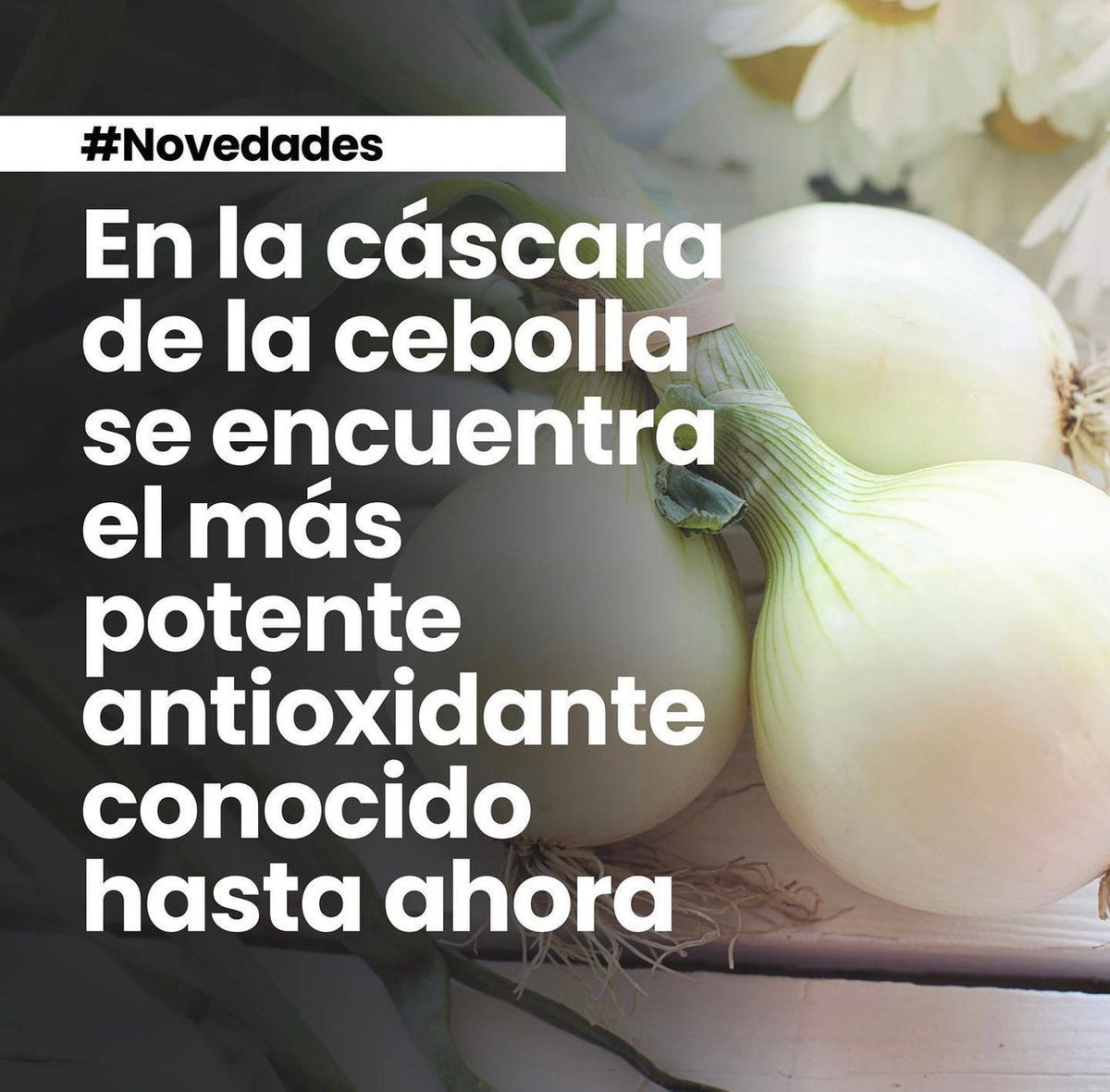
The most powerful antioxidant discovered
|
|
Time to read 4 min

|
|
Time to read 4 min
University of Chile Research
Jocelyn Fuentes and Hernán Speisky, academics at the Antioxidant Laboratory of the Institute of Nutrition and Food Technology (INTA) at the University of Chile, discovered a molecule in onion skin (yellow and purple) whose antioxidant potency is superior to any other antioxidant molecule known until now. The researchers suggest that this finding may pave the way for the development of therapeutic formulas against diabetes and obesity, as well as potential applications in the field of food chemistry and nutritional supplements.
“We discovered an antioxidant in onion skin whose action is exerted at a nanomolar level. This means that the discovered molecule acts on human cells at extremely low concentrations, its potency being—therefore—superior to practically any other antioxidant molecule known until now.” This is how Dr. Hernán Speisky, director of the Antioxidant Laboratory of the Institute of Nutrition and Food Technology (INTA) of the University of Chile, explains the recent discovery of the extraordinary properties of onion skin, made together with the researcher Jocelyn Fuentes, head of the Antioxidant Analysis Laboratory of the same academic unit.
The research began in 2017, in the midst of Professor Fuentes' doctoral thesis process, where the proposed objective was to analyze what happened to antioxidants when they were oxidized, particularly polyphenols. Thus, says the professor, “we found and identified in onion skin that the benzofuranone (BZF) molecule, the oxidized form of the polyphenol quercetin, has an antioxidant potency 1,000 times higher than that of the same non-oxidized polyphenol.”
The experimental research models used by the INTA U. de Chile researchers made it possible to establish that the administration of very low doses of an extract (prepared from dried onion skin), standardized for BZF content, protected experimental animals against damage to their intestinal mucosa and against the alteration of their intestinal barrier function induced by pro-oxidant agents that erode the gastrointestinal tract mucosa, such as NSAIDs (non-steroidal anti-inflammatory drugs) or alcohol.
Likewise, and given that the alteration of intestinal barrier function is a condition that is also frequently associated with obesity and diabetes, the researchers explain that the discovery opens the possibility that the extract developed by the INTA Antioxidant Laboratory could eventually be of enormous therapeutic utility in such conditions.
The studies carried out so far are pioneering, and show that the compound (BZF), naturally present in the dried skin of the onion, behaves in cells as the most potent antioxidant and anti-inflammatory known to date.
The investigation focused on the onion after having studied more than twenty fruits and vegetables known to be rich in the polyphenol quercetin. “We started looking for which foods might contain quercetin in its oxidized state and we arrived at the onion, but the interesting thing was that we did not find it in its flesh, but only in its skin, and specifically in the outermost dry layers. We also saw it in the dry skin of purple onions and shallots, which are a variety of small onions that are consumed a lot in France,” says Professor Fuentes.
Dr. Speisky explains that the research began with the goal of “questioning the scientific assumption that when an antioxidant oxidizes, it loses its antioxidant properties. And for this, we have been working primarily on a type of antioxidants called flavonoids (a class of polyphenols), which are the most abundant natural antioxidants in the human diet.”
In this line, he adds, “using human intestinal epithelial cells exposed to free radicals or agents generating these species (such as NSAIDs or alcohol), we demonstrated that the damage produced at both cellular and molecular levels is completely prevented in the presence of the onion skin extract, as well as by the addition of concentrations of purified BZF added at the same concentration that was present in the extract. Interestingly, the concentrations or doses of benzofuranone required to induce full protection of these cells turn out to be 1,000 times lower than those required by the flavonoid (quercetin) that originates said benzofuranone.”
In addition, he says that “we have supported the above by demonstrating that very low doses of the extract completely protect the intestinal mucosa of experimental animals against oxidative damage and against the loss of intestinal barrier function induced by NSAIDs.” Such findings have recently been published in journals that currently enjoy the highest scientific recognition in the area of antioxidants and food chemistry.
Usually, when we handle an onion for consumption in the kitchen, we remove and subsequently discard the skin to use only the white inner part. So, it is worth asking, how can we use or consume this element in our daily diet? The specialists are clear in clarifying that this corresponds to a second stage and that it is not yet possible to establish its direct consumption as a healthy practice.
“Through a Fondecyt Regular project (1190053) led by Dr. Speisky and a Fondef project (VIU20p0005) that I direct, we have been advancing not only in a greater characterization of the potential uses of BZF, but also in the development of a nutraceutical preparation that contains onion skin extract standardized in terms of BZF. And although we are not yet in a position to suggest its use, let alone doses in humans, initiating clinical studies with the extract is part of our next steps,” asserts Professor Fuentes.
For his part, Professor Hernán Speisky points out that “the interest in antioxidants arises from the broad recognition that the intake of foods rich in molecules—which have the capacity to extinguish or neutralize free radicals—contributes substantively to reducing the risk of developing various non-communicable chronic diseases, such as those that affect the cardiovascular system, the central nervous system, and various forms of cancer.”
Source: https://www.uchile.cl/noticias/183980/academicos-descubren-poderoso-antioxidante-en-cascara-de-la-cebolla-
Antioxidants suggested on our page:
https://ortomolecularchile.cl/collections/antioxidantes


