
Omega 3 - Facts you should know
|
|
Time to read 4 min

|
|
Time to read 4 min
The human body is made up of approximately 37 trillion cells, and each of them contains significant amounts of omega-3 fatty acids that the body needs every day to stay physically and mentally healthy.
Omega-3 EPA and DHA are polyunsaturated fatty acids that have been shown, over decades of scientific research, to provide important health benefits for every cell, organ, and system in the body.
They have been proven to be deficient in the Western diet, which is why the consumption of high-quality supplements becomes a relevant factor.
Some studies indicate that omega-3 supplementation could be a good option for obtaining beneficial effects, without the risk of consuming harmful substances found in fish.
DHA constitutes 20% of the total fatty acids in the cerebral cortex, the outermost layer of the brain, responsible for memory processing and attention; it is also an essential component for the proper functioning of cell membranes, the retina, and sperm. Its highest concentration is in eye tissue, where it represents approximately 30% of total fatty acids.
During pregnancy and breastfeeding, the consumption of DHA-type omega-3 is of special importance for the brain growth and development of the gestating baby.
Between 10% and 15% of pregnant women suffer from postpartum depression at the end of gestation; half of them systematically repeat this type of depression in subsequent births.
Studies have shown that they have low levels of omega-3 fatty acids (Marlene Freeman, U. of Tucson, Arizona). From the age of four and throughout adolescence and adulthood, the intake of EPA, in addition to DHA, becomes relevant for general health.
The American Heart Association recommends that individuals who have risk factors for cardiovascular disease consume 1 gram daily, and those with hypertriglyceridemia ingest between 2 and 4 grams per day.
Among the properties of omega-3, its mildly anticoagulant and anti-inflammatory effects stand out, as well as its contribution to reducing triglycerides and cholesterol, and its protection against cardiovascular disease, arthritis, autoimmune conditions, thrombosis, and all those associated with inflammation.
Some inconclusive studies have linked the consumption of omega-3 to the prevention of Alzheimer's and other neurodegenerative problems.
On the other hand, the intestine houses a large population of microorganisms (colonic microbiota) that are essential for good physical and mental health. A good supply of omega-3 will help this living organ fulfill its functions of supporting the immune system, synthesizing neurotransmitters, and optimizing brain function and that of almost all organic systems.
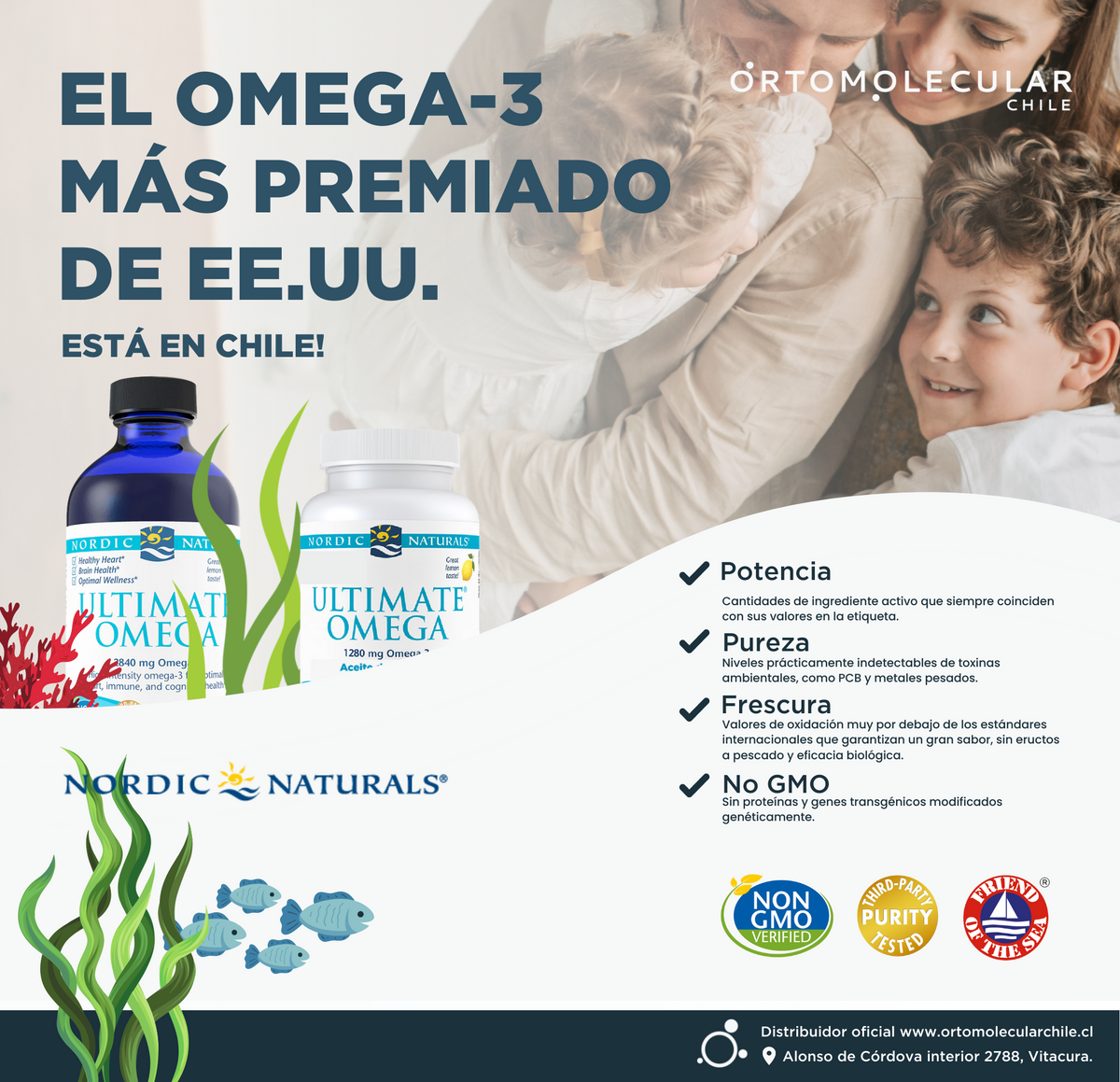
The goal of Nordic Naturals is to produce the best and most effective omega-3 on the planet. 100% of Nordic Naturals fish oil is manufactured in Norway at the Nordic Pharma plant, in the Norwegian Arctic. It is one of the most advanced, state-of-the-art facilities for processing in the omega-3 industry.
Built to pharmaceutical quality standards.
None of the fish used are endangered, and the catch is carried out in the Norwegian Sea from sustainable sources, without damage to the seabed.
Products formulated by experts, proven to be effective, and with great taste, without causing fishy burps and with the highest biological efficacy.
Manufactured with impeccably fresh ingredients and purified using solvent-free technologies in oxygen-free environments with a nitrogen blanket to prevent rancidity.
It is delivered in the triglyceride molecular form, which is the form naturally found in fish. Research has shown that omega-3s in triglyceride form are absorbed up to 80% better than synthetic ethyl ester omegas.
Fish oil contains various types of fatty acids, in addition to EPA and DHA, such as omega-5, omega-7, omega-9, saturated fatty acids, and others.
When Nordic Naturals concentrates the fish oil, some of these other fatty acids are removed to increase the amounts of EPA and/or DHA, which helps to obtain a higher percentage in each capsule.
Nordic Naturals fish oil products offer
various concentrations of EPA and/or DHA.
Each batch is verified to test for potency, purity, freshness, and safety, ensuring it contains no GMO ingredients. You can verify this by entering your product's batch number on the international website to obtain your certificate of analysis (https://www.nordic.com/nordic-promise)
Nordic Naturals plastic bottles do not use phthalates (endocrine disruptors) at any stage of their process. The U.S. EPA and the World Health Organization have strict guidelines regarding phthalates, and Nordic Naturals has always adhered to these standards.
Can adequate amounts of EPA and DHA be obtained solely through fish consumption?
According to the INTA of the University of Chile, fish consumption in Chile is between 7 and 10 kilos per person per year, while the world average is 20.
(https://www.uchile.cl/noticias/142518/investigadores-logran-determinar-cantidad-de-omega-3-en-pescados)
Both fatty acids could be obtained from fish provided there was frequent consumption of at least 100 grams net of fatty fish, especially from cold waters, 3 times a week, but the reality is that many people do not consume adequate amounts
for different reasons:
• Lack of consumption habit
• Lack of knowledge on how to cook it
• No access to places to buy it in the area of residence
• Bad smell and taste accentuated by deterioration caused by storage and transport at risk temperatures
• Fear that the fish may contain environmental toxins (such as mercury, dioxins, PCBs, etc.).
In addition, it must be considered that apart from consumption, there are several factors that can lead to reduced absorption of these essential fatty acids, such as a high intake of omega-6 type oils, like sunflower oil and other vegetable oils; age, a deficient diet, high alcohol consumption, low levels of certain vitamins and minerals, a compromised immune state, as well as an excess of fast food, fried foods, baked goods, saturated fats, and ultra-processed foods also have an impact.
by Nelba Villagrán, Integrative Nutritionist.


