
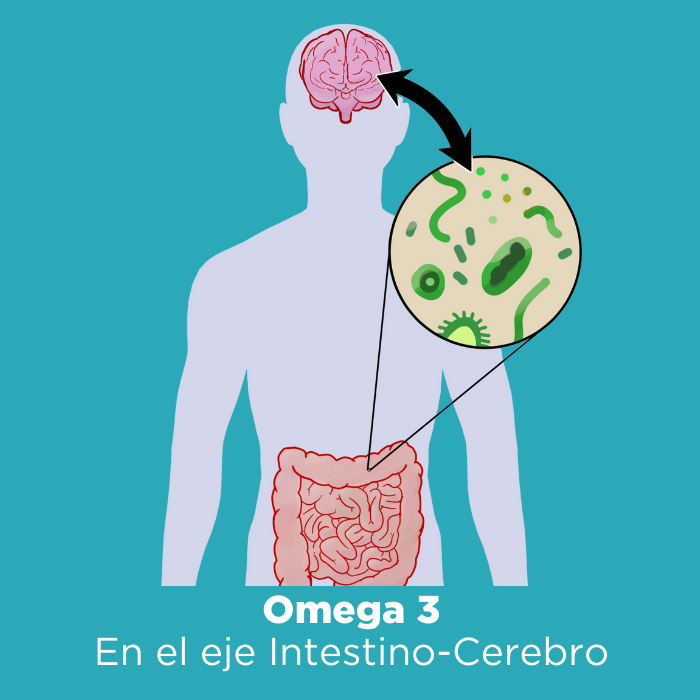
Omega-3 gut-brain axis
|
|
Time to read 9 min

|
|
Time to read 9 min
THE ROLE OF OMEGA-3 IN THE GUT-BRAIN AXIS
Our organism is made up of trillions of cells; specifically, for a 70 kg person, there are on the order of 30 trillion cells in their body. However, it is even more surprising to learn the figure regarding the number of prokaryotic cells or bacteria that populate our intestinal tract, as it is estimated that there are nearly 40 trillion bacteria in our gut [1].
In light of these figures, it is logical to ask: What is the function of these microorganisms? And, more importantly, do they form a symbiotic relationship with the cells of our body?
Evidently, there is no single answer, and it seems logical that their vital relationship with us will depend to a large extent on whether the different groups of bacteria are in an adequate or balanced proportion. This healthy homeostasis of our gut microbiota is what is known as "biosis", and in general terms, we can consider it a bioindicator of our gut health.
Regarding the function of the bacteria in our gut microbiota, it has been classically established that their presence facilitates digestive processes, fiber fermentation, aids in the regulation of intestinal transit, and also provides us with certain essential nutrients such as vitamins K and B12 [2]. However, this is just the beginning, as there is an increasingly deep understanding of the interdependence of our health with that of our intestinal guests. For example, a balanced and diverse gut microbiota is beneficial in the prevention of cardiovascular and metabolic diseases, is capable of synthesizing defensins and other molecules that reinforce the action of the immune system, and some bacteria are even capable of synthesizing neurotransmitters such as serotonin and/or dopamine involved in emotional well-being.
However, when speaking of their function, we must be very cautious, as not all intestinal bacteria have a symbiotic relationship with us; we can also find pathogens and opportunistic pathogens that can damage our health. What happens then?
Given that there are so many inhabitants in our digestive tract, we obviously cannot refer to the different groups of bacteria only in terms of "good" and "bad," but rather we must speak of whether there is a balance or biosis between them.
At this point, and although microbial taxonomy is much more complex, we must consider two main phyla of bacteria with a strong presence in our intestinal tract: "Firmicutes" and "Bacteroidetes." The balance between these two large bacterial groups is fundamental to our health in multiple aspects, from the absorption and metabolism of nutrients such as carbohydrates, vitamins, fatty acids, or bioactive compounds, to the modulation of the immune system and even the development and maturation of the nervous and neuroendocrine systems [2,3].
However, our intestinal biosis in recent decades has been progressively deteriorating due to various causes associated with our lifestyle, leading to talk of a true imbalance or "intestinal dysbiosis" [4,5]. Among its main causes, we should highlight the administration of antibiotics and/or drugs to treat chronic diseases, cesarean sections during childbirth, and, above all, changes in our dietary habits [2].
Of all the factors mentioned previously, the one that takes center stage is nutritional changes. Of particular note is an ever-increasing consumption of omega-6 fatty acids and a lower consumption of omega-3s in Western diets, which has caused an overgrowth of Firmicutes bacteria in parallel with a drastic reduction in Bacteroidetes [4]. The excessive proliferation of bacteria of the genus Firmicutes, especially Fecalibacterium, is associated with a higher prevalence of autoimmune and metabolic diseases such as diabetes, metabolic syndrome, non-alcoholic fatty liver disease [5], and even neuropsychiatric disorders such as depression, stress, and anxiety [6,7].
Faced with this situation, it is normal for us to ask:
Evidently, our diet conditions the type of intestinal guests, and these in turn have a strong influence on our state of health. Faced with an imbalance of this type in our intestinal microbial ecosystem, we must keep very much in mind that the regular consumption of long-chain Omega-3, EPA and DHA, promotes the growth of bifidobacteria, microorganisms capable of synthesizing butyrate and immunoregulatory compounds necessary to alleviate inflammation. It is important to point out that Omega-3 consumption can be accompanied by the intake of probiotics containing bifidobacteria, both factors contributing to achieving the homeostasis of the bacterial flora. This homeostasis favors the production of the protective mucus film of the intestinal mucosa and also encourages the production of immunoregulatory and defensive metabolites against the colonization of the intestinal tract by pathogenic bacteria or opportunistic pathogens. All these effects contribute to minimizing endotoxemia derived from intestinal permeability, helping to prevent inflammatory diseases [4] (Figure 1).

Figure 1: Importance of Omega-3 EPA and DHA in the restructuring of the gut microbiota composition. Supplementation with EPA and DHA rebalances the abnormally high firmicutes/bacteroidetes ratio, preventing the problems of endotoxemia and inflammation that cause intestinal permeability and multiple inflammatory pathologies. Image reproduced from [14].
The fact of considering that our state of health depends in good measure on the composition of the gut microbiota represents a paradigm shift in our nutrition. And despite being an avant-garde approach, it is relatively intuitive to link its influence on certain metabolic diseases such as diabetes, non-alcoholic fatty liver disease, or metabolic syndrome.
However, this link becomes blurred when we think about the possible implication it has on our mental and neurological health.
Without a doubt, this question generates more controversy, and it is understandable given the apparent physical disconnection between the gastrointestinal tract and our brain. However, intestinal biosis and our mental and neuronal health are much more connected than we imagine, even leading to talk of a "Gut-Brain Axis" to refer to the direct and reciprocal communication of the immune system with the gut microbe. In fact, the gut microbiota-brain axis comprises 3 main pathways: nervous pathway, neuroendocrine pathway, and immunological pathway [2].
It is striking that our emotional state and well-being can depend to a certain extent on the composition of our bacterial flora, but the truth is that it has its explanation.
In the first place, we must keep in mind that the intestinal mucosa is highly innervated by neurons of the autonomic nervous system (sympathetic and parasympathetic) in addition to the enteric system. The hepatic and celiac afferent branches of the vagus nerve are capable of detecting mechanical stimuli such as tension or abdominal distension, or chemical ones, such as inflammatory molecules, hormones, and neurotransmitters produced by bacteria, and transmitting these messages to the brain. These stimuli are translated into imbalances in the release of catecholamines at the brain level, with a deficit in dopaminergic neurotransmission being precisely one of the main molecular causes of depression and anxiety.
In addition, the gut microbiota has a great influence on the generation of neurotransmitters such as serotonin and dopamine, again two of them involved in emotional well-being and the prevention of depression. In this sense, certain bacterial species, such as Clostridium perfringens, are capable of increasing serotonin production by increasing the levels of the rate-limiting enzyme in the synthesis pathway. At this point, it is important to point out that this neurotransmitter plays a major role in the management of socio-affective behavior, anxiety, and fear, so it is easy to understand why a deficit of this microorganism in the gut microbiota is associated with a higher prevalence of neuropsychiatric disorders such as bipolar disorder, depression, anxiety, autism spectrum disorders, or childhood phobias [9].
On the other hand, certain imbalances in the composition of the gut microbiota are strongly associated with behavioral disorders such as autism, cognitive impairment, and even ADHD (attention deficit and hyperactivity disorder).
This is because some intestinal bacterial species are capable of modulating the expression of brain-derived neurotrophic factor, BDNF, an essential growth factor for the establishment of synaptic contacts [10]. For this reason, BDNF is fundamental in the prevention of cognitive impairment and autism spectrum disorders, and it has been described that the administration of bifidobacteria, such as Lactobacillus plantarum, to adult patients with cognitive impairment is effective in increasing BDNF levels and reversing cognitive problems [11].
Once again at the heart of the matter, the imbalance between intestinal microbial populations and the increase in intestinal permeability underlie alterations in neuroendocrine secretion. Specifically, an excess of Fecalibacterium and a defect of bifidobacteria can ultimately cause high levels of cortisol, which is the main hormone of the stress response. This is because such microbial imbalance leads to the overproduction of pro-inflammatory cytokines and glucocorticoids, both types of molecules being capable of overstimulating the hypothalamus-pituitary-adrenal axis, causing a massive release of cortisol [12].
More and more studies conclude that supplementation with Omega-3 fatty acids DHA and EPA are effective in combating the causes of stress, anxiety, depression, ADHD, and autism, while also modulating the composition of the gut microbiota. This is because DHA and EPA stimulate the division of bifidobacteria that produce Short Chain Fatty Acids (SCFA). Short-chain fatty acids, such as butyrate, are capable of slowing down the expression of pro-inflammatory cytokines, and can also mitigate the oxidative stress that takes place during inflammatory phases. This effect contributes to short-circuiting the inflammatory feedback loop that leads to the hypersecretion of cortisol, and therefore to stress [2,13, 14].
In addition, supplementation with EPA and DHA contributes to curbing the inflammation occurring in the intestinal mucosa, allowing for the regeneration of the epithelial barrier and the protective mucus layer. This effect decreases the passage of toxins and pro-inflammatory molecules into the bloodstream, thus minimizing neuroinflammation and neurodegeneration [6,14]. In this regard, it is important to highlight that diseases such as depression and/or different senile dementias have a strong neuroinflammatory component that undermines the severity of the disease. For this reason, high-concentration EPA and DHA supplementation is an effective strategy to combat these types of diseases, whether directly through the beneficial effects of Omega-3 at the cerebral and cognitive level, or due to its capacity to restore biosis to our gut microbiota (Figure 2).

Figure 2: Bidirectional regulation of Omega-3 fatty acids with the balance of the gut microbiota. Omega-3 EPA and DHA favor the restructuring of the gut microbiota composition, encouraging a positive feedback loop that leads to a decrease in inflammation and better neurotransmission. Image reproduced from [2].
Arrived at this point, we can conclude that there is a bidirectional regulation between the consumption of Omega-3 fatty acids and the balance of our gut microbiota. EPA and DHA fatty acids stimulate the growth of bifidobacteria that produce short-chain fatty acids, contributing to restoring microbiological balance at the intestinal level. For their part, this type of bacteria, in cooperation with Omega-3, decreases the production of inflammatory mediators, thus reducing endotoxemia and preventing the appearance of inflammatory, neuroendocrine, and neurodegenerative pathologies [14].
For its part, a more diverse gut microbiota contributes to providing adequate levels of neurotransmitters such as serotonin or dopamine, strongly involved in emotional behavior, and even growth factors such as BDNF, vital to prevent autism spectrum pathologies, ADHD, and cognitive impairment associated with advanced age [2].

Figure 3: Summary diagram of the anti-inflammatory and anti-aging effects of Omega-3 EPA and DHA on various vascular, cerebral, and metabolic pathologies. The beneficial effects of Omega-3 are due both to their direct action on different organs and systems, as well as their ability to rebalance the composition of the gut microbiota.
Dietary supplementation with Omega-3 EPA and DHA, together with probiotics, helping to restore gut microbiota homeostasis, constitute a natural synergy for achieving symbiosis in the health of our gastrointestinal and cerebral tracts (figure 3).
Check out our Omega 3 collection: https://ortomolecularchile.cl/collections/omega-3
BY DR. ALBERTO RAMPEREZ MARTIN.
Nelba Villagrán
Orthomolecular and Integrative Nutritionist, Minsal-certified naturopath.


